
What Immersive Learning Actually Looks Like in an Indian Classroom

In one line: Immersive learning means a student stops reading about a thing and instead stands inside it — walks through a cell, watches a chemical reaction up close, stands in an ancient market. This blog skips the hype and shows what that actually looks like, subject by subject, in a real Indian classroom.
Search "immersive learning" and you'll drown in the same three claims: a big retention percentage, a line about "the future of education," and a photo of a smiling child in a headset. All of it is true enough. None of it tells a school principal the one thing they actually want to know: what does a lesson look like, and what changes in my classroom on a normal Tuesday?
This blog answers that. We'll define immersive learning in plain words, then walk through what it looks like in science, maths and social science — and what the teacher is doing the whole time.

What immersive learning really means
Immersive learning is a simple idea dressed up in a big phrase. It means learning by being inside an experience instead of only hearing or reading about it.
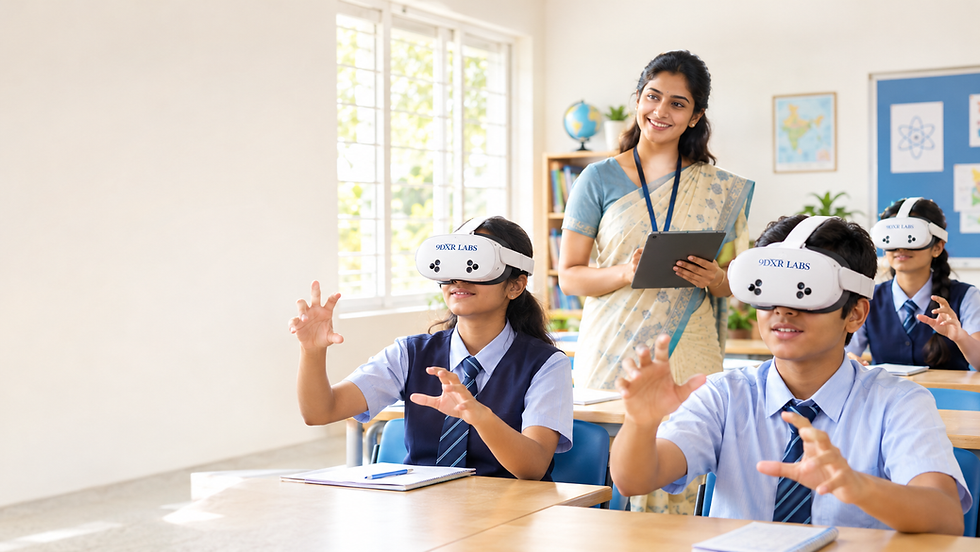
The immersive technology that makes this possible in schools is mainly virtual reality (VR) — a headset that places the student inside a 3D world they can look around and act in. Some schools also use augmented reality (AR), which adds digital objects on top of the real room through a tablet. Either way, the point is the same: the student gets an immersive experience of the thing being taught, not just a description of it.
Here's the honest distinction worth making. "Immersive learning" is the approach. The headset is just the tool. A school doesn't adopt immersive learning because headsets are exciting — it adopts it because some things are almost impossible to understand from a flat textbook diagram, and far easier to grasp when you can walk around them.
📖 Read more: AR vs VR in Education: The Difference, for Schools — which immersive technology does what
Why Indian schools are moving towards it
Two things are pushing immersive learning into Indian classrooms.
The first is NEP 2020. The National Education Policy asks schools to move away from rote memorisation towards experiential, hands-on learning. For a lot of concepts — a dissection, a historical site, a planet's orbit — a true hands-on experience is expensive, unsafe, or simply impossible in a school. An immersive classroom closes that gap: students get the hands-on experience without the lab hazards or the field-trip budget.
The second is the exposure gap. Not every school has a well-stocked science lab, and very few can take students to a museum, a power plant or a heritage monument. Immersive technology brings those places to any classroom with a few headsets — which is why it's often framed as a tool for fairness, not just for novelty.
A measured note, because the internet is full of inflated numbers: immersive learning doesn't magically multiply exam scores. What it reliably does is make abstract ideas click faster and stick longer, because the student experienced them instead of memorising them. That's the real benefit, and it's enough.
What an immersive lesson actually looks like — subject by subject
This is the part most articles skip. Here's what a student actually does.
Science — a Class 10 chemistry practical. Instead of watching the teacher demonstrate one reaction at the front of the room (or not seeing it at all, if the lab is short on chemicals), each student runs the reaction themselves in VR. They pour the reactants, watch the colour change and gas form up close, and repeat it as many times as they like — with no burns, no fumes, no broken glassware. A reaction that was a paragraph in a textbook becomes something they did with their own hands.
Maths — a geometry or mensuration topic. Solid shapes are where flat textbooks fail hardest. A student struggling to picture the cross-section of a cone, or how a 2D net folds into a 3D box, can pick the shape up in VR, turn it, slice it, and see the maths happen. Volume and surface area stop being formulas to memorise and become something visible.
Social Science — a history or geography lesson. Instead of reading about the Indus Valley or a river system, the student walks through it. They stand in the streets of a planned ancient city, or follow a river from its source to the sea. Geography and history become places the student has been, not chapters they've skimmed.
The pattern across all three: the immersive experience doesn't replace the teacher or the textbook. It gives the student a first-hand encounter with the thing, so the teacher's explanation lands on something real.
What this means for the teacher
The biggest worry principals raise is "my teachers aren't technical." Worth addressing head-on: in a well-designed immersive classroom, the teacher doesn't need to be.
Modern school VR is built so a regular teacher can launch a lesson, guide the class, and track every student from a simple dashboard — no coding, no complicated setup. Good providers also include immersive training for teachers, so the staff running the lab are comfortable with it from day one. The teacher's job doesn't shrink; it shifts — from delivering information to guiding an experience and leading the discussion that follows.
📖 Read more: Hand Tracking vs Controllers in a School VR Lab — why simpler controls mean less time lost in a period
What to look for if you're considering it
If your school is weighing immersive learning, the questions that actually matter aren't about the technology — they're about the teaching:
Is the content mapped to your syllabus?
Immersive lessons should follow NCERT / CBSE / ICSE chapters, not sit beside them as extras.
Does it cover more than one subject?
The strongest immersive classrooms span science, maths and social science, so the room earns its place.
How much of the lesson is experience vs thinking?
The best programmes keep headset time short and discussion long.
Is teacher training included?
Without it, the headsets gather dust.
Can one teacher run a full class?
If managing the room needs a specialist, it won't last.
Bringing immersive learning into your school
Immersive learning isn't a glimpse of some far-off future — it's running in Indian classrooms today, in ordinary science, maths and social science periods. The schools getting value from it treat it as a teaching method, not a gadget: short immersive experiences, strong discussion, content tied to the syllabus, and teachers who are trained and in control.
If you want to see what that looks like for your subjects and grades, the clearest next step is to look at the actual lesson content.
Read more from 9DXR Labs
AR vs VR in Education: The Difference, for Schools — the two immersive technologies, explained plainly
VR Experiments for CBSE Class 10 Science, Chapter by Chapter — immersive science, lesson by lesson
How a VR Lab Fits Inside an Atal Tinkering Lab — immersive learning in a makerspace
Hand Tracking vs Controllers in a School VR Lab — what makes an immersive classroom easy to run
AR VR Lab for Schools in India: Space, Equipment and Setup — setting up the room


Comments