
VR Experiments for CBSE Class 10 Science: The Full Practical List (Chapter by Chapter)

Updated: Sep 21
Every Class 10 science practical on the syllabus — and how students can do each one safely in virtual reality.
Talk to any Class 10 science teacher about practicals and you'll hear the same problems: there's never enough lab time, some chemicals are too dangerous or too costly to hand to 40 students, equipment breaks, and students don't get to repeat an experiment enough times for it to really sink in. Then the board practical exam shows up — and for a lot of students, that's the first time they're doing some of these experiments properly.
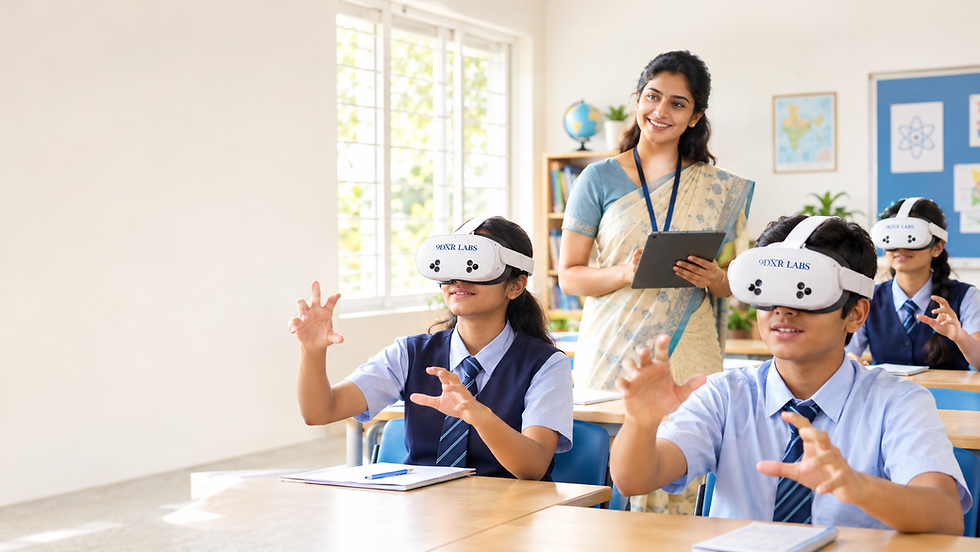
A VR science lab fixes this in a simple way. Instead of one shared lab with limited supplies, every student puts on a headset and does the real experiment with their own hands — safely, as many times as they want, and matched exactly to the syllabus.
Here's the full list of CBSE Class 10 science practicals for 2025–26, sorted by subject, with how each one works in a 9DXR VR lab.

The full CBSE Class 10 science practical list
The board has 14 experiments across Chemistry, Physics and Biology. Here's every one.
Chemistry practicals in VR
1. Finding the pH of samples. Students test HCl, NaOH, vinegar (ethanoic acid), lemon juice, water and baking soda solution using pH paper or an indicator. In VR, the colour changes right away and students match it to the pH scale — with as many samples as they like and nothing to spill.
2. Properties of acids and bases. Reactions of HCl and NaOH with litmus, zinc and sodium carbonate. In VR, students see the gas bubble up and the litmus change colour instantly, and they can run it again and again.
3. Types of chemical reactions. Combination, decomposition, displacement and double-displacement reactions. Some of these are messy or tricky to do in a classroom — in VR they work every time.
4. Reactivity series of metals. Testing Zn, Fe, Cu and Al with different salt solutions and putting them in order of reactivity. In VR there's no cost every time a student uses up metals and salts.
5. Properties of acetic acid. Its smell, how it dissolves, what it does to litmus, and how it reacts with baking soda. Students try it all hands-on — without ever touching the real acid.
6. How well soap cleans in hard vs soft water. A simple side-by-side test that's easy to see clearly in VR.
Physics practicals in VR
7. Ohm's Law. Looking at how the voltage across a resistor changes with the current, and drawing the V–I graph. In VR, students build the circuit, take the readings, and the graph draws itself as they go — no blown fuses, no loose wires.
8. Resistance in series and parallel. Working out the total resistance in each setup. Students can rewire in seconds and compare, which is much faster than rebuilding a real circuit.
9. Focal length of a concave mirror and a convex lens. Using a faraway object. VR gives you a perfect "faraway object" and a clear view of the light rays every time.
10. Refraction through a glass slab. Following the path of light at different angles and measuring how much it shifts. In VR you can actually see the ray of light — something a real glass slab can't show you.
11. Refraction through a glass prism. Following the light ray and watching it split into colours. The rainbow shows up clearly, so students really get the idea.
Biology practicals in VR
12. Looking at stomata. Making a leaf-peel slide and viewing the stomata up close. In VR, students get a clear, zoomable view without the fiddly job of preparing a slide.
13. CO₂ given off during breathing. Showing that carbon dioxide is released when we breathe out. A clean, easy-to-repeat demo in VR.
14. Cell division and seed parts. Looking at binary fission in Amoeba and budding in yeast/Hydra from slides, and finding the parts of a seed. In VR the process is animated, not just a still picture on a slide.
Why VR works better than a real lab for these ?
Not every experiment needs to move to VR — but for the Class 10 list, the wins are clear:
It's safe. Acids, bases, reactive metals and electric circuits all carry real risk with 40 students in the room. In VR, all of it is completely safe.
They can repeat it. The one thing that helps most in the practical exam is doing the experiment more than once. VR lets students try it as many times as they want, at no extra cost — no buying more chemicals or replacing broken glass.
They can see what's really happening. Light rays, colours splitting through a prism, gas forming, cells dividing — VR shows the thing itself, which a real lab often can't.
Every student gets a turn. No sharing one setup with the whole class. Each student does the full experiment with their own hands, because it uses hand-tracking — there are no controllers to figure out.
How a teacher runs these in class ?
It usually goes like this: the teacher picks the day's experiment from the dashboard, students start it with one tap, they do it in VR with the AI mentor guiding them, and the teacher watches everyone's progress and scores update live. Because it follows the CBSE syllabus, it fits straight into your normal lab schedule instead of adding more work.
Frequently asked questions(FAQs)
Do these VR experiments match the CBSE board practical exam?
Yes. Every experiment here is from the CBSE Class 10 practical list for 2025–26, so students practise exactly what the board tests.
Can VR fully replace the real lab?
Most schools use VR alongside the real lab — doing the dangerous, costly or hard-to-repeat experiments in VR, and keeping the real lab for basic handling skills. Using both together works best.
Do students need to know VR already?
No. 9DXR uses hand-tracking, so students just use their hands — there are no controllers to learn. Most are up and running within a minute.
How much space does it need?
Much less than a science lab — a normal classroom works fine. Each student only needs a little clear space.
See it with your own syllabus
The easiest way to get it is to watch a Class 10 experiment run from start to finish. Book a free demo and we'll show your science team the practicals that matter most to your school.
9DXR Labs builds VR science labs for schools across India — hands-on experiments with AI guidance and hand-tracking, no controllers and no physical lab needed.


Comments