
Hand Tracking vs Controllers in a School VR Lab

When a school buys a VR lab, one decision quietly shapes everything that follows: how students will interact with what they see.
Most systems on the market still hand every student two controllers. A smaller number let students use their own hands. The difference sounds technical, but it shows up in lesson time, in your annual budget, and in what your students actually take away from the experiment.
Here is how the two compare across the things that matter in a classroom.

The two approaches
Controller-based VR gives each student two handheld devices. Buttons, triggers and thumbsticks are mapped to actions — one button picks something up, another releases it, a thumbstick moves you around. This design comes from gaming, where a player has hours to master an interface and precision aiming matters.
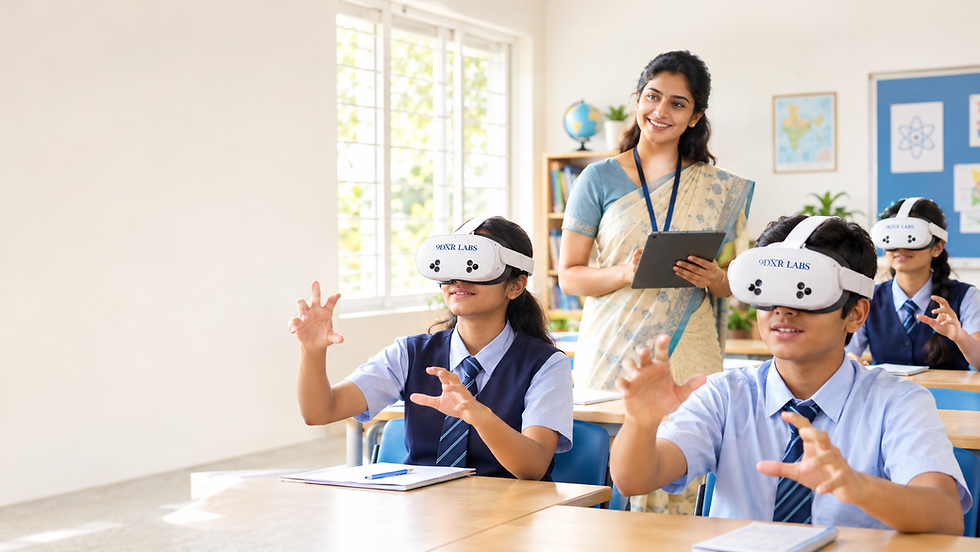
Hand-tracked VR has no controllers. Cameras on the outside of the headset watch the student's hands, and around sixty times a second a machine learning model predicts the position of all twenty-six joints in each hand. Reach out, close your fingers around a beaker, and you are holding the beaker.
Both put a student inside a virtual laboratory. What differs is everything about how they get there.
The comparison at a glance
Controllers | Hand tracking | |
Time to first experiment | 5–10 minutes explaining which button does what | Immediate — students reach out and begin |
Devices per student | 3 (headset + two controllers) | 1 |
Batteries to manage | 2 per student, ongoing | None |
Items that can be lost or broken | 2 per student | None |
Before a lesson can start | Check charge, check pairing, distribute matched pairs | Hand out headsets |
Changeover between sections | Collect and redistribute every controller | Headsets only |
Recurring consumable cost | Ongoing replacements | None |
Classes 1 - 8 | Button mapping takes time to learn at that age | Immediate |
Students who don't play games | Noticeably slower start | No difference |
What students physically practise | Pressing triggers, holding buttons | Real laboratory hand technique |
Across a twenty-headset installation, that first section compounds quickly. Controllers make it sixty devices and forty batteries to keep working. Hand tracking makes it twenty headsets in a cabinet.
Lesson time: the difference is measured in minutes
A gamer has unlimited time to learn an interface. A science teacher has one period, and part of it goes on settling the class and fitting straps.
With controllers, the first several minutes of a session go on interface instruction — which button grabs, which one releases, why the view moved when it shouldn't have. That instruction has to be repeated for every new class, and partially repeated each time a class returns after a gap.
With hand tracking there is nothing to teach. Students already know how to pick something up. Headsets go on and the experiment begins.
In a forty-minute period, that difference frequently decides whether a class finishes the experiment or runs out of time part-way through.
What students actually learn
This is where the two approaches diverge most sharply, and it's the argument that carries most weight with academic staff.
In a science practical, the hand movement is the skill being assessed. Tilting a pipette to the correct angle. Gripping a test tube near the top. Moving steadily because the liquid will slosh. Adjusting a microscope's focus.
A controller maps all of that onto a trigger. The student learns a sequence of button presses that produces the right outcome on screen. What their body remembers afterwards is holding a device and squeezing.
With hand tracking, the student performs the real movement. The motor memory that forms is a memory of pipetting, of pouring carefully, of handling glassware — because those are the actions their hands carried out. When that student later stands at a physical bench, their hands already know something useful.
Daily operations: what the lab coordinator lives with
Schools feel this one every week.
A controller-based lab needs charging overnight, batteries replaced each term, left-and-right pairs kept together, and pairing checked before a lesson. Controllers get dropped, go missing, and end up in the wrong box. Anything requiring routine attention in a school tends to drift out of use, because there is rarely a technician standing by.
A hand-tracked lab is one headset per student. Take them out of the cabinet, hand them out, start the lesson. There is nothing to pair and nothing to assemble, which means the lab still works on the Monday after a long holiday.
Cost: the part that isn't in the quotation
Controllers are a consumable. They are dropped, lost and replaced, and every replacement is a purchase order. Over a three-year period that becomes a predictable recurring line in the budget — one that rarely appears in the original proposal.
Hand tracking removes that line entirely. There is no accessory to replace, because there is no accessory.
Who engages, and who hangs back
Handheld controllers are instantly familiar to students who play video games and considerably less so to students who don't. In the first minutes of a session that difference is visible to the entire class — some students confident straight away, others hesitant and waiting for help.
Hand tracking removes that gap. Every student in the room has been using their hands since before they could speak, so nobody's starting position is on display. First-session confidence is a strong predictor of engagement months later, which makes this a bigger deal than it first appears.
Where the industry is heading
Hand tracking has improved substantially over the past two years. Systems now recover instantly when a hand leaves view and returns, handle fast movement smoothly, and hold a natural hand position throughout — the refinements that turn a capability into something you can build a curriculum around.
It is also the direction the whole category is moving. The newest headsets from the major manufacturers are designed around hand and gaze input rather than handheld devices. A school choosing hand tracking today is not betting on an experimental feature — it is adopting the input method the industry is converging on.
Frequently asked questions
Why do many school VR systems still use controllers?
Mostly because their content was written for them. Software designed around buttons doesn't become hand-friendly by changing a setting — the interactions have to be authored for hands from the beginning. Worth asking any vendor whether their experiments were built for hand tracking or merely support it.
Do students need training to use hand tracking?
No. That's the central advantage. Teachers need around two hours to learn the dashboard and run a session; students need none.
Does it suit younger students?
Particularly well. Younger students find button mapping hardest, so removing it helps them most. Our experiments run from Class 1 upwards.
What does the teacher control?
Everything runs from a dashboard — launching an experiment to every headset at once, seeing who has completed what, and where individual students are spending time.
How does this map to the CBSE practical syllabus?
Our experiments are mapped chapter by chapter to the NCERT practical syllabus for Classes 1 to 12 — more than 1000 of them. You can see the full Class 10 practical list here.
The short version
Controllers were designed for gaming, where players have hours to learn an interface and precision aiming decides the outcome.
A classroom works on different terms. Forty minutes. Students who have never used VR before. Large groups with no technician on hand. Skills assessed on how a student handles apparatus. On every one of those, hand tracking is the better fit — and it is where the technology is heading anyway.
The fastest way to settle it is to watch a student who has never worn a headset put one on and simply begin. It takes about ten seconds. We're happy to bring a set to your school and let a class try it during a normal period.
9DXR Labs builds hand-tracked VR science labs for schools across India, with 1000+ experiments mapped to the NCERT practical syllabus for Classes 1 to 12, plus a teacher dashboard for running and tracking sessions. New to this? Start with our complete guide to VR labs for schools in India.


Comments