
Who Builds VR Science Labs for Schools in India? A Buyer's Guide

Short answer: VR science labs for Indian schools are built by four kinds of providers — free simulation platforms, browser-based virtual lab makers, robotics/STEM-lab companies that bolt on AR/VR, and dedicated immersive-VR lab companies. The right one depends on how deep the content is, which classes and subjects it covers, whether it needs controllers, and how much teacher support comes with it.
Start searching for a VR lab for your school and you'll hit a wall of websites that all sound identical — "VR," "AR," "immersive," "future-ready." One's selling robot kits. One's selling software. One's selling headsets. They all use the same words, and none of them tells you who actually does what.
Let's fix that. This guide doesn't rank companies. It explains the types of VR lab providers in India, what each is genuinely good at, and the exact questions to ask before you spend a rupee. Read it once and you'll see straight through the sales pages.
Who builds VR science labs for schools in India?
VR science labs come from four different kinds of provider — not one. Spotting which kind you're dealing with is the whole trick, because they sell very different things under the same three letters.

Type of provider | What they actually give you | Best for |
Free simulation platforms | Flat, on-screen science simulations, no headset. Free. | Quick practice on a computer, zero budget |
Browser-based"virtual labs" | Interactive labs that run in a web browser on a screen. | Low cost, simple setup, no headsets |
Robotics/STEM-lab companies | Mostly robotics, coding and electronics, with AR/VR added as one extra item. | A mixed maker/robotics room |
Dedicated immersive-VR lab companies | Full VR labs — headsets, curriculum-mapped 3D lessons, teacher tools and training. | Schools wanting hands-on, immersive learning as the main event |
Here's the one line to remember: a "virtual lab" and a "VR lab" are not the same thing. A virtual lab runs on a screen. A real VR lab puts the student inside the lesson with a headset. If you want immersive, hands-on learning, you're after the fourth type.
What to look for when choosing a VR lab provider
Once you know the type, judge any provider on these six things. It's the checklist most schools wish they'd had before they signed.
Does the content match your syllabus?
Lessons should be mapped to NCERT / CBSE chapters, not sit beside them as extras. Ask to see the chapter list.
Which classes and subjects are covered?
Some cover only senior science. The strongest cover Classes 1–12 across science, maths and social science, so the lab earns its keep all year.
How many lessons are there, really?
A few demo experiences is a world apart from a full library of hundreds of curriculum-linked modules.
Controllers or hands?
Headsets that need two hand controllers mean more setup and more to lose. Hands-only (hand-tracking) headsets are far easier to run.
Can an ordinary teacher run it?
Look for a one-tap teacher screen and an in-headset guide, so a non-technical teacher can lead a class and track every student.
Is teacher training and support included?
On-site training at setup, plus someone to call afterwards, is what keeps a lab in use instead of in a cupboard.
📖 Read more: Hand Tracking vs Controllers in a School VR Lab — why the controller question matters more than it sounds
Questions to ask any VR lab vendor before you buy
A short, honest set of questions that quickly sorts the strong providers from the weak:
"Can I see your lesson list mapped to our board and classes?"
"How many curriculum-aligned modules are included?"
"Do your headsets use controllers, or hands only?"
"Can one teacher run a full class, and what does the teacher screen show?"
"What training and after-sales support is included?"
"Can we book a free demo at our school before we decide?"
If a vendor can't answer the first two clearly, their content is probably thin. A good provider will happily show you the chapter list and bring a demo to your school.
Where 9DXR Labs fits
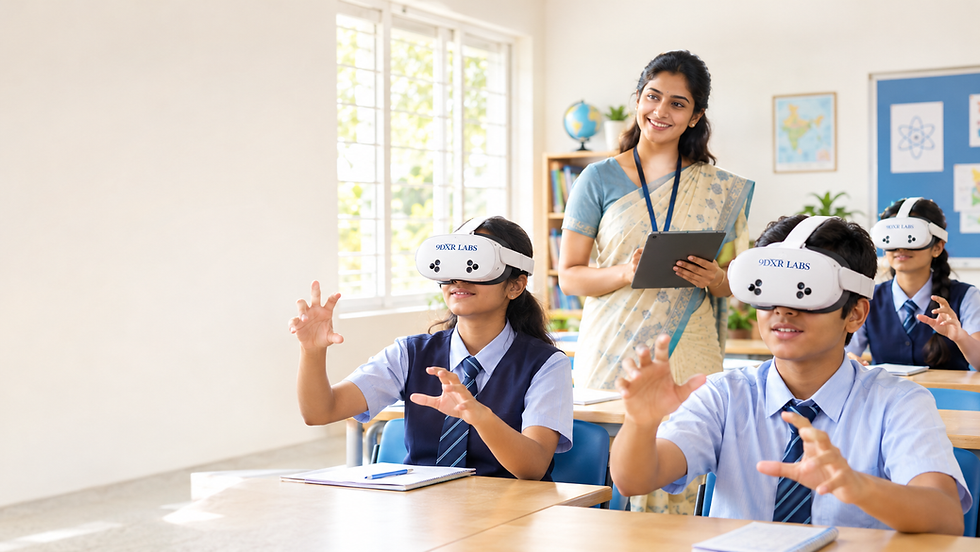
Straight up, so you know where we sit: 9DXR Labs is a dedicated immersive-VR lab company — the fourth type above. Our lab uses hands-only headsets with no controllers, 1,000+ curriculum-aligned modules across science, maths and social science for Classes 1–12, a one-tap teacher screen, and on-site teacher training. If that's the kind of lab you're after, the best next step is to see it in your own classroom.
And if, after the checklist, a browser-based virtual lab or a robotics-first room suits your school better — that's a fine choice too. The point isn't to pick us; it's to match the provider type to what you actually need.
Frequently asked questions
Who builds VR science labs for schools in India?
Four types of provider do: free simulation platforms, browser-based virtual lab makers, robotics/STEM-lab companies that add AR/VR, and dedicated immersive-VR lab companies that supply headsets, curriculum-mapped 3D lessons, teacher tools and training. The right type depends on whether you want screen-based or fully immersive learning.
What's the difference between a virtual lab and a VR lab?
A virtual lab usually runs on a computer or browser screen. A VR lab uses a headset to place the student inside the lesson in 3D. VR is more immersive and hands-on; a virtual lab is simpler and cheaper to run.
How do I choose the right VR lab for my school?
Check that the content is mapped to your syllabus, covers the classes and subjects you need, includes enough modules, uses easy (ideally controller-free) headsets, can be run by an ordinary teacher, and comes with training and support. Always ask for a free school demo first.
Which VR labs cover more than just science?
The strongest providers cover science, maths and social science across Classes 1–12, so the lab is useful across the whole school, not just one subject.
Read more from 9DXR Labs
Hand Tracking vs Controllers in a School VR Lab — a key thing to check in any headset
Running a VR Lab Without Being a Tech Expert: A Teacher's Guide — can your teachers run it?
What Immersive Learning Actually Looks Like in an Indian Classroom — what students actually do
AR VR Lab for Schools in India: Space, Equipment and Setup — space and setup


Comments